.svg "The X Report Logo;; (1)")

JULY 2026

What drives value in the convergence of training providers, employers, and learner-workers? - The vocational education space is growing, and much faster than just through demographics and inflation. We’re not surprised by this – although the specific mix of drivers can vary substantially by segment and activity.

A global snapshot of the EdTech, HealthTech & Impact Investing markets.

Notable M&A & Fundraising activities across EdTech & HealthTech industries

Global trends across the tech-led Education, Training and Health sectors.
Education Industry Analysis – Q2 2026
Healthcare Industry Analysis - Q2 2026

The value of convergence between education services and employment services – career and skills development in a challenging world
By Ian Koxvold, Partner at Cairneagle
It’s difficult to analyse the vocational education market. You have the training providers (long courses, short courses) and certification (exams, aptitudes, behaviours), you have early-career preparation and upskilling, you have different funding buckets (employer-paid, learner via the Student Loans Company, learner out-of-pocket, government funding) and so on.
What does become clear with any analysis is that this space is growing, and much faster than just through demographics and inflation. We’re not surprised by this – although the specific mix of drivers can vary substantially by segment and activity.
From our extensive work in this space, I’ve picked out three themes to explore:
1. The convergence of vocational training, certification and support in career paths will be the greatest growth area in the education landscape over the coming five years
The natural translation of education into work / careers has been broken over the last decade. We see simultaneously near-record levels of unemployed young people (at eye-watering cost to treasuries and society) and near-record levels of skill gaps.
We see the growing importance of signalling commitment (for learners) and reducing time to competence (for employers). The accelerating pace of tech-enabled transformation and disruption of industries means that continued learning is now vital. The growing inequality in quality of life (linked to earnings, but also to housing costs) puts more pressure on success, at the same time that the application to appointment rate for many attractive roles has become very challenging.
Every piece of research we do suggests that learners, employees, employers, and government will all increase their spend commitment to these challenges over the next decade or more.
2. Averaging is the enemy – in analysis of markets and marketing, and of customer segments and their buying behaviour.
There’s recently been a new wave of assessment of the value of a degree that concludes that medicine and economics is good, and that creative arts are bad. This is conflating many factors – including the quality of teaching, the level of early conviction around career, the career chosen (there are music degree grads in banking, but there are more economics graduates!), level of competition etc.
John Hattie developed a rather extraordinary meta-analysis of meta-analyses to develop his Visible Learning toolkit. I don’t think there’s an equivalent for career success – although much of the component research is available.
Even without this maybe-panacea, there’s a lot of power in being more specific. One of my criticisms of many universities has been that they chase volume growth without clarity on what their specific proposition is, or on how to establish differentiation. Without differentiation it is very hard to fend off higher-ranked institutions, and you can still be defeated in detail by lower-ranked ones. This is not just a problem for Higher Education.
We continue to find that the right way to analyse any of these issues is at the “use case” level – that is, the specific underlying problem that a specific customer segment is trying to solve. While there are no magic answers to any complicated analysis, doing the work at a detailed level and aggregating it is infinitely preferable to combining multiple average numbers (which inherently reduces the level of visible variation in the answer).
3. The blurring of boundaries between needed services is driving a new wave of aggregation – either through partnership or acquisition.
It’s about much more than just education and certification. If you look at the challenges that learners and employers wrestle with in work they include recruitment, performance management, learning & development, and HR operations. We have a list of seventeen specific needs across these that can be explicitly supported by better training and assessment – and the value at stake is huge.
Outside of work (before a career, between jobs, or outsourced service), the supporting ecosystem is also very large – encompassing recruitment (well over £100bn in the UK), a wide range of training providers, and all sorts of HR services businesses.
We are seeing some very interesting investment theses around joined-up propositions, especially supported by an ability to leverage data across relationships.
So, what’s our diagnosis? Where are the biggest opportunities?
We see many opportunities – but I think the biggest is in building sector-focussed combinations of training, certification, skills assessment and career opportunity mapping. Bringing together – under one roof or through partnership – the tools needed to connect talent and employment, and to help both workers and employers to progress through a career has huge value for them and for the service providers that support them.
I expect to see multiple £20m+ platforms like this – and they could come out of careers platforms, data providers, recruiters, industry bodies, assessment providers or education & training groups. Doing it well will present a first-mover advantage in any particular sector, so it will be very interesting (for us, and others) to see who has the ambition to pursue that opportunity.
Ian Koxvold is a partner in Cairneagle, the leading independent education strategy consultancy. His email is ian.koxvold@cairneagle.com.

.png "EdTechX Banner 600 x 100 (6)")
🎥Missed the opening keynote at EdTechX Summit 2026?
To kick off the 12th edition of EdTechX last month, Charles McIntyre (CEO & Founder) and Rory Henson (Partner) of IBIS Capital took the stage to revisit a bold set of predictions from last year... and the results were hard to ignore. Watch the full opening keynote here.

📝Artificial Intelligence and the Future of Entry-Level Work
Artificial intelligence (AI) is reshaping how organizations hire, develop and advance talent, and this is most visible at entry-level. Globally, more than one in three young workers are employed in occupations with medium to high exposure to AI-driven task change. How these roles evolve will have significant implications for organizational performance, workforce participation and economic mobility. (World Economic Forum)
🏛️ The Big Four Issues Reshaping Global Higher Education in 2026
International higher education in 2026 is facing one of the most complex periods of change in decades. Universities are being reshaped by tighter migration rules, demographic decline, financial pressure, artificial intelligence, geopolitical tension, and rising questions about the value of a degree. This piece examines the four structural forces driving that reordering, and the countertrend that may define the next decade.(Global Nexus)
👨🎓What Does an AI-Ready Graduate Look Like?
Aligned to existing ISTE standards and principles, the expanded Profile of an AI-Ready Graduate defines six roles and associated skills and practices students should have mastered when they graduate. (EdTech magazine)
💰 Digital health funding hits $7.4B in 2026 as AI investment reshapes the market
As AI technology rapidly advances, it's resetting expectations, reshaping the funding environment and changing the competitive landscape. (Fierce Healthcare / Rock Health)
🎗️AI in Mental Health 2026: Clinical Infrastructure Wins, Wellness Apps Are Priced Out
Mental health funding hit record levels in 2026, but capital is concentrating sharply on a very specific shape of company. The pattern across the top-funded rounds is clear: psychiatry copilots, AI scribes, hybrid clinician–AI platforms, payer-aligned workflows, and proprietary clinical data. Generic LLM chatbots, standalone meditation apps, and pure voice-biomarker plays are being walked away from. This article maps where mental health AI capital is actually flowing, where it has stopped, and where the white space sits for founders and innovation partners. (research2guidance)
👩⚕️How physician CEOs hone the double-edged sword of clinical training
The journey from physician to CEO has no prescribed path, but those who’ve reached the top reveal how they evolved the strengths and instincts forged in clinical training for enterprise leadership. (McKinsey & Company)
🌐Human agency is the next frontier for impact investing
For decades, impact investing has expanded our understanding of value. We learned that capital can generate financial returns while improving lives, strengthening communities, and protecting the planet. We invested in education, healthcare, financial inclusion and climate resilience because we recognized that human potential is both an economic and social asset. Artificial intelligence now challenges us to rethink that assumption once again. (ImpactAlpha)
💡BCG Commits $500 Million to AI for Social Impact by 2030
AI has enormous potential to help address some of the world's most pressing social challenges. Yet the organizations best positioned to act on that potential often remain significantly underresourced. To help close that gap, Boston Consulting Group (BCG) announced it will commit $500 million by 2030 to AI for social impact, focusing on the organizations most poised for transformative impact and large-scale system change. (Boston Consulting Group)
📈 Europe posted its strongest venture funding quarter in 4 years as UK gains, M&A holds up
In Q2, Europe posted its strongest quarter in four years for venture funding, Crunchbase data shows. All told, Europe-based startups raised $24 billion in the just-ended quarter, up around a third quarter over quarter and two-thirds higher than the $14.4 billion raised in Q2 2025. (Crunchbase)

Education



Source: Capital IQ / Tracxn
Health



Source: Capital IQ / Tracxn
Education

Source: Capital IQ / Tracxn
Health


Source: Capital IQ / Tracxn
M&A Overview
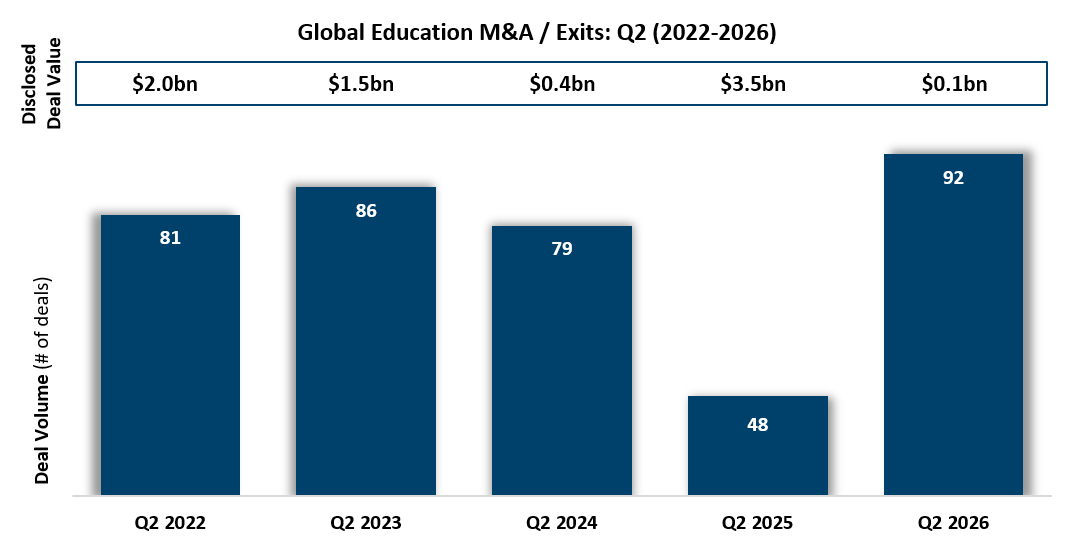
Global M&A activity across the education, work and training sector expanded sharply in Q2 2026, with deal volumes increasing 92% year-on-year to 92 completed transactions, compared with 48 in Q2 2025. Aggregate disclosed deal value declined to approximately $0.15bn, reflecting the absence of large-platform transactions in the period and a continued pattern of strategically significant but undisclosed deals, consistent with Q1 2026.
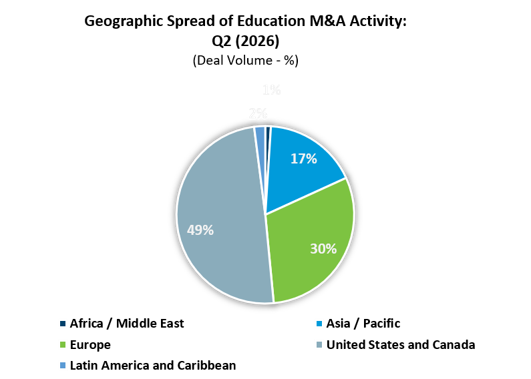
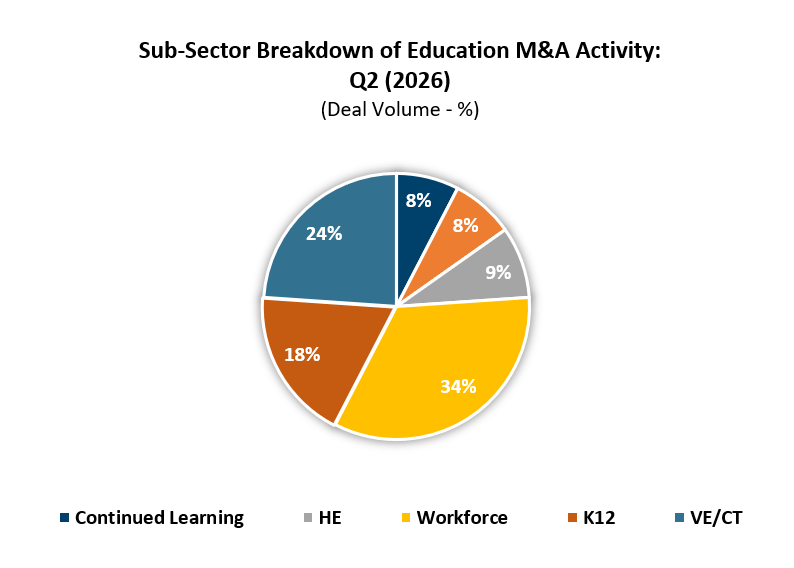
Deal activity in Q2 2026 reflected a continuation of themes that dominated the latter part of 2025, with momentum concentrated in AI-enabled human capital management, workforce staffing consolidation, and vocational and professional training. North America was the most active region by volume, accounting for approximately 49% of transactions, followed by Europe at 30% and Asia Pacific at 17%. By sector, workforce technology and HR services remained dominant at approximately 34% of deal activity, with vocational education and corporate training at 24% and K12 at 18%.
Key Themes
Workforce technology remains an active theme
AI-native hiring and workforce management platforms attracted sustained acquirer interest in Q2 2026, with strategic buyers targeting assets that embed intelligent automation directly into recruitment, onboarding, and talent management workflows. Key transactions include:
-
Grayscale, the US-based AI-powered recruiting automation company, was acquired by Paylocity. The transaction extends Paylocity’s HCM platform into AI-powered high-volume hiring automation, targeting enterprise clients in warehousing and healthcare where candidate engagement at scale is a material operational challenge.
-
Aurio, the Germany-based AI-powered hiring agent platform, was acquired by Personio, the HR, talent and payroll platform. The acquisition integrates proactive AI sourcing capability into Personio’s HR software suite, strengthening its position as a full-lifecycle people management platform.
Staffing consolidation
The staffing segment saw continued consolidation across specialist and technical disciplines, with strategic acquirers targeting platforms with established client relationships, sector-specific expertise, and geographic scale. Key transactions include:
-
GEE Group, the Jacksonville-based provider of professional staffing services across IT, accounting, finance, engineering, and healthcare, was acquired by Star Equity Holdings, Inc. (Nasdaq: STRR). GEE Group operates under multiple specialist brands including Ashley Ellis, Paladin Consulting, Agile Resources, and Staffing Now, and the transaction expands Star Equity’s presence in professional and technical workforce solutions.
Corporate training and vocational education
Transaction activity across corporate training and vocational education remained active in Q2 2026, with acquirers targeting specialised providers in cybersecurity training, orthodontic education, language learning, and corporate leadership development. Key transactions include:
-
Capslock, the UK-based provider of cybersecurity training and a train-hire-deploy talent pipeline for organisations seeking to source, develop, and retain cyber professionals, was acquired by MThree. The acquisition expands MThree’s established technology talent solutions business into the fast-growing cybersecurity skills segment, addressing one of the most acute talent shortages in enterprise technology.
-
RareJob, the Tokyo-based provider of online english conversation, reskilling, and corporate language development services, was acquired by Gakken (TSE: 9470) for approximately $16m. RareJob operates across individual consumer, corporate, and institutional segments, offering ALT dispatch, qualification support, and global leader development programmes. The transaction consolidates Gakken’s position across the Japanese education and corporate training market.
Outlook
M&A activity across the education, work and training sector is expected to remain selectively active in H2 2026, with acquirer appetite concentrated in AI-enabled workforce technology, cybersecurity training, and scalable vocational and professional development platforms. The sharp increase in deal volume in Q2 2026, without a commensurate increase in disclosed values, is indicative of a market in which consolidation is being driven by smaller, strategic bolt-on transactions rather than large-platform deals, a pattern expected to continue as buyers prioritise capability and customer acquisition over transformative scale.
The ACT/ETS combination signals a broader structural consolidation across the global assessment and credentialing market, which is likely to attract further regulatory and competitive scrutiny, potentially catalysing additional transactions among assessment and test preparation platforms. In the AI hiring and workforce technology segment, continued investment in agentic automation is expected to sustain both strategic M&A and venture-backed growth activity, with platforms capable of delivering measurable improvements in time-to-hire, candidate quality, and workforce productivity commanding premium valuations.
Fundraising Overview
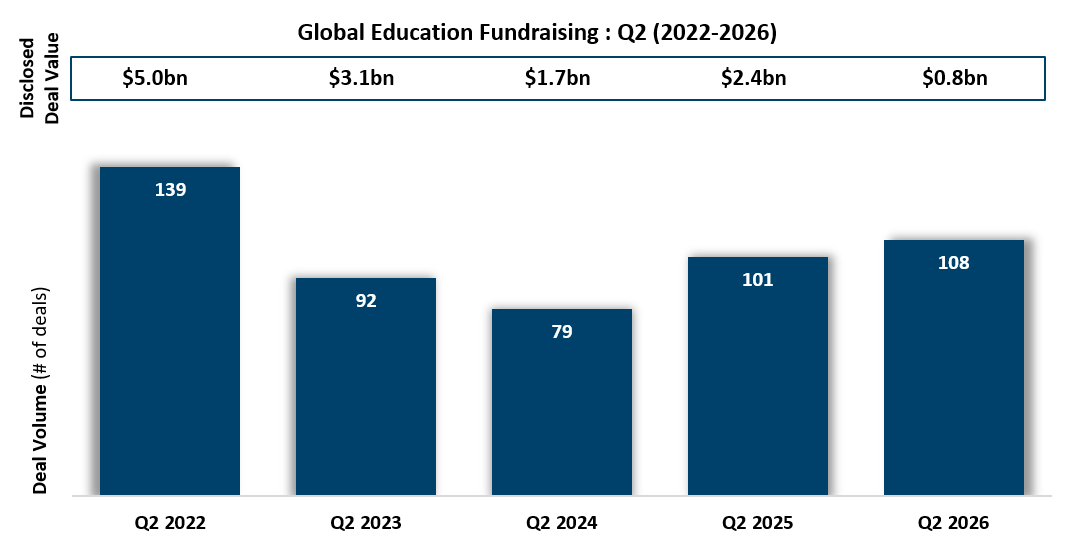
Fundraising activity across the education, work and training sector remained broadly stable in Q2 2026, with fundraising volumes increasing modestly to 108 transactions from 101 in Q2 2025, while aggregate disclosed deal value declined by approximately 66% year-on-year to $839m, compared with $2.4bn in the prior-year period. The reduction in disclosed value reflects the absence of large-scale growth rounds that characterised Q2 2025, rather than a structural withdrawal of investor appetite, with the quarter producing several material transactions across AI-enabled workforce technology and professional training.
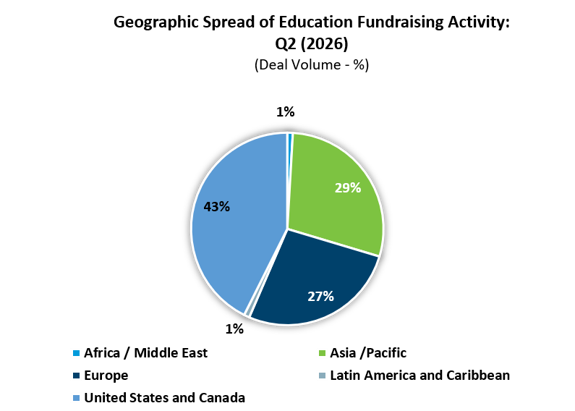
Deal activity in Q2 2026 reflected a continuation of themes that dominated the latter part of 2025, with momentum concentrated in AI-enabled human capital management, workforce technology, and K12 and lifelong learning platforms. North America was the most active region by volume, accounting for approximately 43% of transactions, followed by Asia Pacific at 29% and Europe at 27%. By sector, workforce technology attracted the largest share of capital at approximately 23% of deal activity, with K12 edtech at 35% when combining K12 and K12 classifications, and vocational and corporate training at a combined 17%.
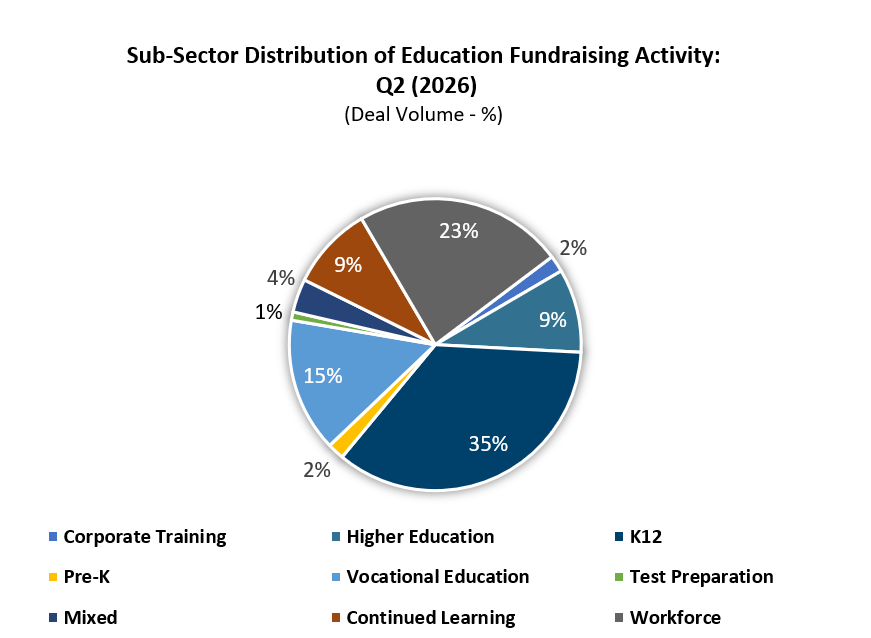
Seed and early-stage transactions dominated by volume, consistent with the broad-based innovation activity observed across the sector. Growth-stage capital was concentrated in a smaller number of high-conviction platforms, with Everyday Software ($150m Series D), Stepful ($55m Series C), BibliU ($55m Series C), Multiverse ($70m), and Zum ($100m Series F) representing the most material disclosed rounds of the quarter.
Key Themes
AI-Powered HR and Workforce Platforms
AI-native workforce and HR platforms attracted the largest concentration of disclosed capital in Q2 2026, with investors continuing to prioritise platforms that embed intelligent automation into payroll, benefits, recruitment, and workforce management. Key transactions include:
-
Everyday Software, the Spain-based provider of all-in-one HR platform for SMEs, raised approximately $150m in a Series D round led by General Catalyst, with participation from Atomico and The Four Rivers Group. The transaction is one of the largest growth rounds in European HR technology in recent quarters and reflects sustained investor conviction in integrated, AI-enabled people management platforms serving small and medium-sized enterprises across southern Europe and Latin America.
-
RemotePass Inc, the US-based HR and EOR provider, raised $17m in a Series B round from a consortium including Endeavor Capital, BECO Capital, Wamda Capital, and the EBRD Venture Capital Investment Program. The transaction supports RemotePass’s expansion of its global payments, multi-currency payout, and EOR immigration capabilities for organisations managing distributed international workforces.
Corporate training and vocational education
Fundraising in corporate training and upskilling platforms reflected continued employer and investor demand for scalable workforce development infrastructure, with capital concentrated in platforms demonstrating measurable skills outcomes and strong institutional client relationships. Key transactions include:
-
Multiverse, the UK-based provider of technology and data apprenticeship programs, raised $70m from a consortium including Lightspeed Ventures, StepStone Group, Index Ventures, General Catalyst, D1 Capital Partners, Bond Capital, and Schroders Capital. Multiverse serves professional clients across the UK and US, offering apprenticeships in data analytics, software engineering, project management, and business analysis, and the transaction supports its continued expansion of AI-native upskilling and reskilling capabilities.
-
Stepful, the Detroit-based provider of online healthcare training, certification, and job placement programmes, raised $55m in a Series C round. Stepful’s platform combines online instructor-led training, in-person clinical placements, and career coaching, serving hospital systems, clinics, and healthcare organisations seeking trained frontline professionals.
K12 and curriculum technology
K12 edtech attracted the highest transaction volume of any segment in Q2 2026, driven by broad-based seed and early-stage activity across AI tutoring, adaptive learning, school safety, and student transportation. Capital concentration at the growth stage was more selective, with investors prioritising platforms with demonstrated institutional adoption and defensible technology differentiation. Key transactions include:
-
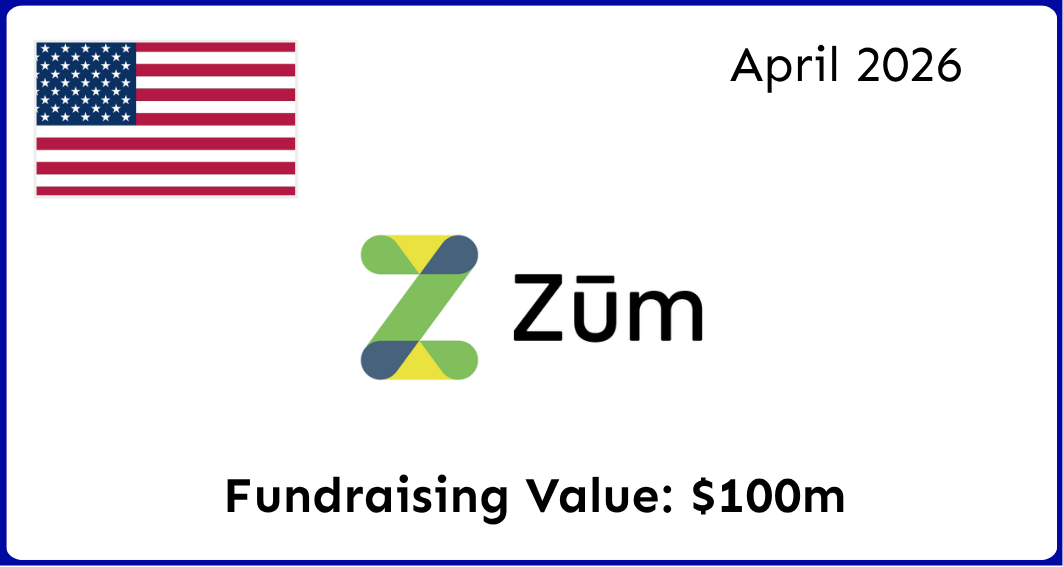
Zum, the US-based digital platform connecting students, drivers, and school districts to deliver managed student transportation services, raised $100m in a Series F round led by TPG. The transaction represents the largest single disclosed round in the K12 segment in Q2 2026, reflecting investor conviction in technology-enabled school transportation as a scalable, recurring-revenue district services business with significant network effects.
-
BibliU, the UK-based provider of digital learning content and campus store management solutions for higher education, raised $55m in a Series C round from BlackRock and Stonehage Fleming. BibliU’s platform enables institutions to provide students with digital textbooks and course materials, and the transaction positions the business for continued expansion of its content partnerships and institutional client base across North America and the UK.
Outlook
Fundraising activity across the education, work and training sector is expected to remain active in H2 2026, with capital concentration likely to increase further in AI-enabled workforce platforms and established upskilling businesses with demonstrable enterprise traction. The Everyday Software Series D and ORBIO AI Series A signal continued European investor confidence in HR technology, while the Stepful and Multiverse transactions reflect growing institutional appetite for professional training platforms operating at the intersection of skills development and labour market outcomes.
In the K12 segment, the Zum Series F and Gizmo Series A illustrate the breadth of investment themes attracting growth capital, from district infrastructure and transportation to AI-native consumer learning tools. Continued seed activity across AI tutoring, adaptive learning, and school safety platforms is expected to sustain deal volumes through H2 2026, though the graduation of these businesses to Series A and beyond will be contingent on demonstrating institutional adoption and scalable unit economics.
Global activity in Q2 2026 reflected a continuation of investment themes that has dominated recent quarters, with sustained momentum in AI-powered clinical decision support, remote patient monitoring, and digital therapeutics. Across both M&A and fundraising, acquirers and investors continued to prioritise platforms with demonstrable clinical validation, scalable enterprise customer bases, and the capability to embed intelligent automation into provider, payer, and patient workflows.
M&A Activity
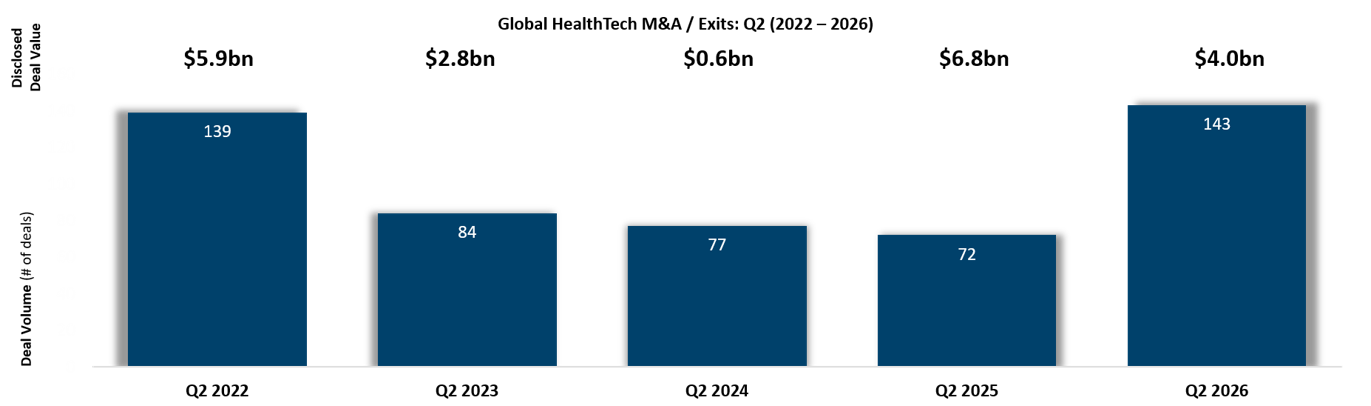
M&A activity across the HealthTech sector in Q2 2026 was characterised by several notable transactions and strong activity as we observed deal counts rise by 99% compared to the prior year, increasing to 143 deals in the quarter. These deals spanned AI-powered diagnostics, clinical workflow automation, and healthcare IT infrastructure. Strategic acquirers prioritised assets with established clinical validation and recurring enterprise revenue, while financial buyers continued to target profitable healthcare software businesses with defensible market positions.
Healthcare IT and Digital Health Infrastructure
Q2 2026 saw continued strategic consolidation across healthcare IT, clinical data management, and digital health infrastructure, with acquirers targeting assets that improve operational efficiency, interoperability, and AI-enabled clinical workflow. Key transactions include:
- TrueBridge, the US-based provider of healthcare IT solutions, was acquired by Inventurus Knowledge Solutions, for approximately $547m. The transaction reflects the continued acquirer appetite for scaled, recurring revenue HER and RCM businesses serving the community hospital segment.
- Doctolib SAS completed a secondary transaction in which A.P. Møller Holding, Athos KG, and Generation Investment Management acquired a combined stake for approximately €315m ($346m), representing a significant ownership transition for Europe’s leading digital health appointment and care coordination platform. Doctolib serves over 80 million patients across France, Germany, and Italy, and the transaction reflects continued institutional confidence in scaled European digital health infrastructure with a clear path to profitability.
Fundraising Activity
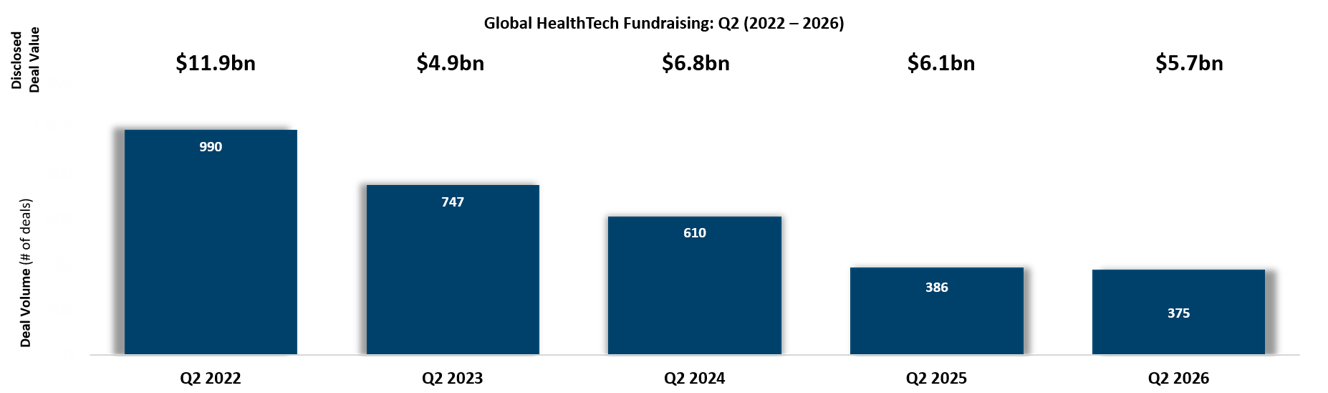
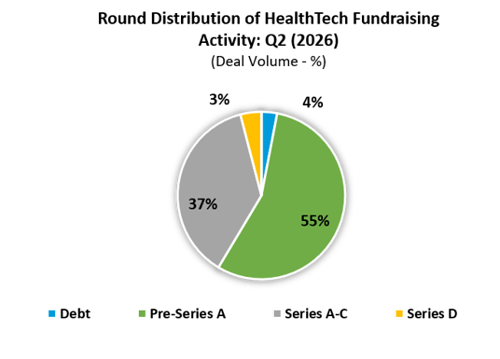
Fundraising activity across HealthTech in Q2 2026 comprised 375 disclosed transactions, with capital distributed broadly across all stages. Pre-Series A transactions accounted for approximately 37% of deal volume, consistent with continued early-stage innovation activity across AI diagnostics, digital therapeutics, and remote patient monitoring. Growth-stage capital of Series B and above was concentrated in a smaller number of established platforms.
Series A-C transactions represented approximately 55% of volume, reflecting a pipeline of emerging HealthTech businesses moving from proof-of-concept into commercial traction. The quarter produced several material growth rounds across digital health infrastructure, AI-powered clinical tools, and specialty therapeutics, with the United States, United Kingdom, and Finland among the most active geographies for disclosed growth capital.
Geography
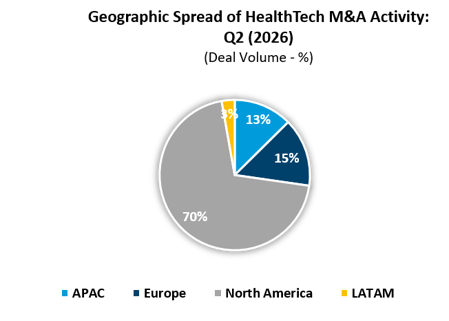
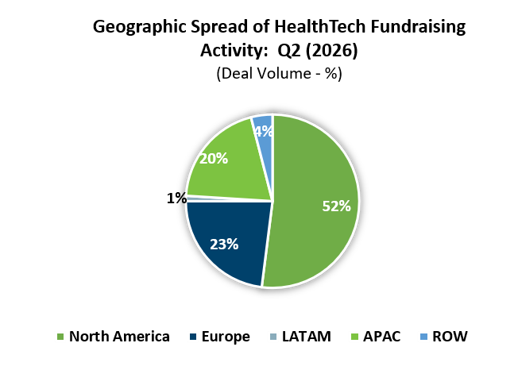
North America accounted for approximately 70% of M&A volume and dominated aggregate disclosed transaction value in Q2 2026. Europe accounted for approximately 15% of M&A volume and approximately 23% of fundraising transactions, with the United Kingdom, Germany, France, Netherlands, Sweden, and Belgium among the most active markets.
Asia Pacific represented approximately 13% of M&A volume, with China, Japan, South Korea, and Australia the most active markets. Latin America and emerging markets contributed a small but growing proportion of both M&A and fundraising volume, with Brazil, India, and Southeast Asia generating activity concentrated in digital health platforms and pharmacy e-commerce.